Drills
Used Drill Presses on Tabletop for Sale
A drill press is one of the most practical machines in any shop. Compared to handheld drilling, a drill press provides
better control, more consistent hole placement, and improved repeatability. This category focuses on industrial and shop drill presses,
including single head drill presses often used for light production, maintenance departments, fixtures, and general fabrication work.
Drill presses are commonly used for drilling, countersinking, spot-facing, reaming, and light tapping. In many operations,
they are a simple way to improve accuracy and throughput without adding unnecessary complexity.
Showing the single result
-
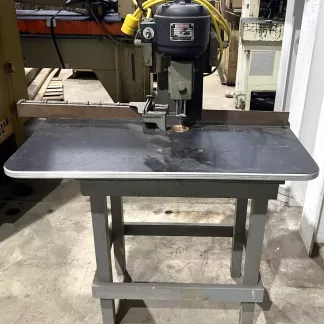
115V Pioneer Drill Press • Used Drill Press for Sale
1 Request a Quote115
Volt6"
Bed R-L3"
StrokeSpeed: - SPM Power Tools for SaleUsed Pioneer DrillMachine #6838
Jackson, MI Cooper BuildingSale Price: $99
Single Head Drill Presses
A single head drill press uses one spindle to perform drilling operations with consistent feed and alignment.
These machines are popular when you need repeatable results, quick setups, and a dedicated station for common hole patterns or secondary operations.
Featured example: Pioneer Ohio single head drill press
You may see compact units like a 0.25 HP, 115V Pioneer Ohio Single Head Drill Press (example model:
913D3452R). Machines in this class are typically chosen for lighter-duty drilling tasks, small parts,
workstations with standard power availability, and applications where a compact footprint matters.
What drill presses provide
- Improved hole accuracy: Better alignment and consistent feed vs. handheld drilling.
- Repeatability: Easier to hold consistent hole location and depth across multiple parts.
- Cleaner finishes: More stable cutting can reduce chatter and improve hole quality.
- Safer, more controlled operation: Workholding and controlled feed help reduce common drilling issues.
Common drill press applications
- General fabrication and maintenance drilling
- Drilling hole patterns in fixtures, brackets, and plates
- Countersinking and spot-facing for fasteners
- Reaming operations when alignment matters
- Light tapping (machine dependent)
Key specs that matter
- Horsepower (HP): Impacts cutting capacity and how aggressively you can drill larger diameters.
- Voltage: Common options include 115V for light-duty stations and 230/460V for heavier industrial machines.
- Spindle speed range: Determines suitability for different materials and drill sizes.
- Quill travel: How far the spindle can move, affecting maximum depth capability.
- Throat depth: Distance from column to spindle center, affecting reach and part clearance.
- Table size and adjustability: Influences fixturing and ease of setup.
FAQs: Drill presses
What is the difference between a drill press and a milling machine?
A drill press is designed primarily for vertical drilling and related operations. A mill is designed for cutting in multiple axes and can perform
more complex machining. Drill presses are a simpler, cost-effective solution when drilling is the primary need.
Is 0.25 HP enough for a drill press?
For light-duty drilling, small hole sizes, and common shop tasks, 0.25 HP can be sufficient. Cutting larger diameters in thicker materials typically
requires more horsepower, slower speeds, and rigid workholding.
Why is spindle speed important?
Different materials and drill sizes perform best at different speeds. Too fast can overheat the tool and reduce life. Too slow can cause poor finishes
and higher cutting forces. A useful speed range improves versatility.
What helps improve hole accuracy the most?
Proper workholding, sharp tooling, correct speed/feed, and a rigid setup matter most. Even a great drill press will struggle if the part can move,
or if the drill is dull or running at the wrong speed.
Can a drill press tap holes?
Some drill presses can handle light tapping with the right setup, speeds, and tapping tools. For frequent tapping or larger threads,
dedicated tapping machines or mills are typically preferred.
Showing the single result