Thermal Care
Thermal Care Industrial Process Chillers
Thermal Care is a recognized name in industrial process cooling and temperature control. Their chillers are engineered to remove heat
efficiently and maintain stable process temperatures across demanding manufacturing environments. The result is more consistent production,
improved repeatability, and better protection for heat-sensitive equipment and tooling.
Thermal Care chillers are commonly used anywhere a process needs dependable cooling and tight temperature stability, including plastics processing,
metalworking support systems, hydraulic power unit cooling, welding and laser loops, and general industrial process water circuits.
[split]
What Thermal Care chillers provide
- Stable temperature control: Helps keep process temperatures consistent, supporting repeatable results and predictable cycle times.
- Efficient heat removal: Designed to pull heat out of the process reliably, even under changing production loads.
- Industrial durability: Built for real plant conditions where uptime matters and cooling is not optional.
- Flexible configurations: Chillers may be packaged for standalone use or integrated into broader plant cooling strategies.
NQ Series: portable and packaged process cooling
The Thermal Care NQ Series is a popular chiller platform for facilities that want a practical footprint and a self-contained cooling solution.
“Portable” and “packaged” chillers are often chosen because they simplify installation and make it easier to dedicate cooling to a specific machine,
line, or process loop. This approach is especially useful when production layouts evolve over time or when certain cells require independent temperature control.
In many plants, a packaged chiller is the backbone of process stability. It helps manage heat load swings during ramp-ups, changeovers, and long production runs,
keeping temperatures closer to target so equipment can perform as intended.
Typical uses for industrial process chillers
Process chillers support a wide range of applications, including:
- Plastics processing support (auxiliary equipment, tooling circuits, and process water loops)
- Hydraulic systems (oil-to-water heat exchangers and hydraulic power unit cooling)
- Pressroom support cooling (hydraulics, tooling circuits, and temperature-sensitive subsystems)
- Welding and laser processes (cooling loops where stable temperatures protect equipment performance)
- General industrial cooling for manufacturing equipment and process utilities
Why temperature stability matters
In production environments, heat can silently cause problems: drifting dimensions, inconsistent surface finish, variation in material behavior,
and higher stress on pumps, seals, and components. A properly applied process chiller helps reduce those risks by keeping temperatures steady,
which supports consistent quality and improved uptime.
Performance features engineers typically care about
When evaluating industrial chillers (including Thermal Care platforms), the features that most often impact real-world results include:
- Cooling capacity: Enough capacity to handle your process heat load without temperature drift.
- Flow and pressure capability: Supports proper heat transfer through the equipment and piping.
- Control behavior: Maintains stable supply temperature as loads change.
- Plant-ready electrical: Compatible with common industrial voltage and phase requirements.
- Serviceability: Practical access for maintenance in real plant conditions.
Portable and packaged chillers in modern manufacturing
As manufacturers push for higher throughput, tighter tolerances, and more frequent changeovers, process cooling becomes more important, not less.
Portable and packaged chillers provide a scalable way to add dedicated cooling to specific operations, keeping critical processes stable without
overcomplicating plant utilities.
Showing the single result
-
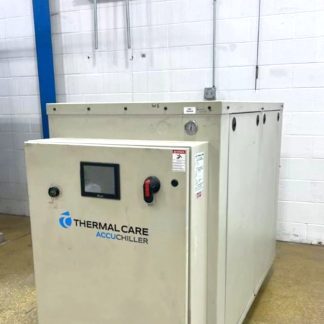
12 Ton Thermal Care NQ Series Portable & Packaged Industrial Chiller
36 Request a Quote10
Compressor Motor Size12
Cooling Capacity30
Reservoir CapacityGood for approx. 500-1,000 ton standard hydraulic press (75-100 hp motors) or a 300-500 ton heated platen press.Used Stand Alone Chilling SystemIndustrial Chillers for SaleUsed Closed Circuit Chiller SystemModel NQVW10Year: 2017High-Capacity Water-Cooled Process Chiller, 10 HP Scroll Compressor, 7-Inch Color Touchscreen, Eco-Friendly RefrigerantMachine #8414
Jackson, MI Cooper BuildingStarting Price: $
Showing the single result