Nano
Used & Reconditioned nano Chillers for Sale
When process temperature matters, a dependable industrial chiller is not optional. It protects product quality, stabilizes cycle times,
and helps prevent unplanned downtime. This page features used and reconditioned nano process chillers currently available,
along with practical guidance to help you choose the right unit for your application.
Who is nano?
nano (often referenced as nano Purification Solutions) designs industrial process chillers built for
accurate temperature control, efficient heat transfer, and reliable performance
in demanding manufacturing environments. Their chillers are commonly configured as closed-circuit systems,
which can help maintain consistent water quality and support stable process temperatures.
[split]
Why nano chillers are a great option
- Closed-circuit reliability: Closed-loop cooling helps reduce contamination and supports consistent process temperatures.
- Precise process control: Stable cooling reduces scrap and improves repeatability, especially when heat loads fluctuate.
- Industrial-ready configurations: Many models can be configured with different cooling capacities, pump options, tank sizes, and electrical requirements.
- Reduced operating headaches: Robust design and model-specific features can support efficient, stable operation in real plant conditions.
Why buying used makes sense
A used nano chiller can be an excellent value when you want industrial performance without new-equipment lead times or pricing.
Used and reconditioned chillers are especially attractive when:
- You are adding capacity for a new program or bid
- You need a fast replacement for a down chiller
- You want a backup unit to reduce downtime risk
- You are expanding a line and want to match an existing cooling strategy
Common applications for nano process chillers
Industrial process cooling is used across a wide range of operations. Depending on your setup, a nano chiller can support:
- Hydraulic systems and oil-to-water heat exchangers
- Welding and laser cooling loops
- Plastics processing and molding support equipment
- Pressroom auxiliary cooling (controls cabinets, hydraulics, tooling circuits)
- General process water temperature management
What to check when selecting a nano chiller
To size and select correctly, it helps to gather a few basics:
- Cooling capacity needed (tons or BTU/hr)
- Temperature setpoint range and stability requirements
- Flow rate and pressure requirements at the machine (pump curve matters)
- Electrical (voltage / phase / Hz)
- Connection size and plumbing layout (hose routing, filtration, fittings)
- Reservoir volume (helps buffer load swings)
- Ambient conditions (heat, dust, plant temperature, seasonality)
If you are not sure where to start, share what you are cooling, the target temperature, and any known flow/pressure requirements.
That is usually enough to point you toward the right class of unit.
Availability and new arrivals
This page may show only one unit today, but it is still worth checking back. Industrial process chillers move quickly,
and the “right” unit often depends on a narrow combination of voltage, cooling capacity, pump option, and connection sizes.
Tip: If you do not see the exact nano model you need, it is often possible to source a comparable unit by matching
performance requirements (capacity, setpoint range, pump curve, and electrical).
Quick FAQ
Are nano chillers a good fit for closed-loop process cooling?
Yes. Closed-loop configurations are a common preference for stable industrial cooling and can help reduce contamination compared to open systems.
How do I compare used vs new?
Start with performance requirements (tons, setpoint, flow/pressure, voltage), then compare lead time, cost, and any upgrades needed to meet your plant standard.
What information should I have ready when requesting a quote?
Ideally: desired temperature setpoint, estimated heat load/capacity needed, required flow/pressure, electrical (voltage/phase/Hz), and your connection sizes.
Showing the single result
-
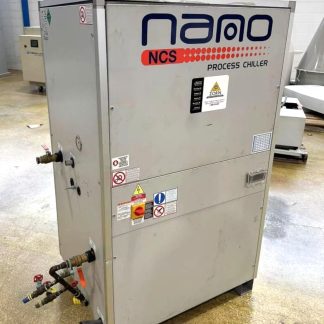
3.6 Ton Nano NCS Process Industrial Chiller
18 Request a Quote460
Voltage3.6
Cooling Capacity15.9
Reservoir CapacityGood for approx. 100-200 ton standard hydraulic press (20-30 hp motors) or a 30-50 ton heated platen press.Used Stand Alone Chilling SystemIndustrial Chillers for SaleUsed Closed Circuit Chiller SystemModel NCS 0031USYear: 2020High-Efficiency Cooling Unit Manufactured In 2020, Designed For Reliable Temperature Control In Industrial Processing Applications.Machine #8413
Jackson, MI Cooper BuildingStarting Price: $
Showing the single result